Brexit has cost Murcia a quarter of its fruit and vegetable exports to the UK, and competitors are filling the gap
As the tenth anniversary of the Brexit referendum approaches, new data reveals the lasting damage to one of the region's most important agricultural markets
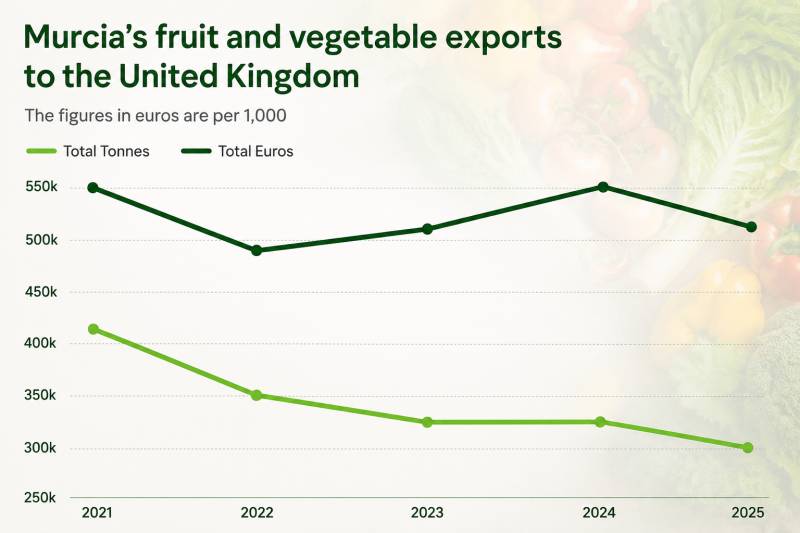
Ten years on from the Brexit vote, the consequences for Murcia's agricultural sector are still very much being felt. Total fruit and vegetable exports from the region to the United Kingdom have fallen by 26% in volume since 2021, the first full year after the UK effectively left the EU single market. In tonnage terms, that means a drop from 406,868 to 301,577 tonnes. Revenue has also slipped, down 6% from €550 million to €515 million.
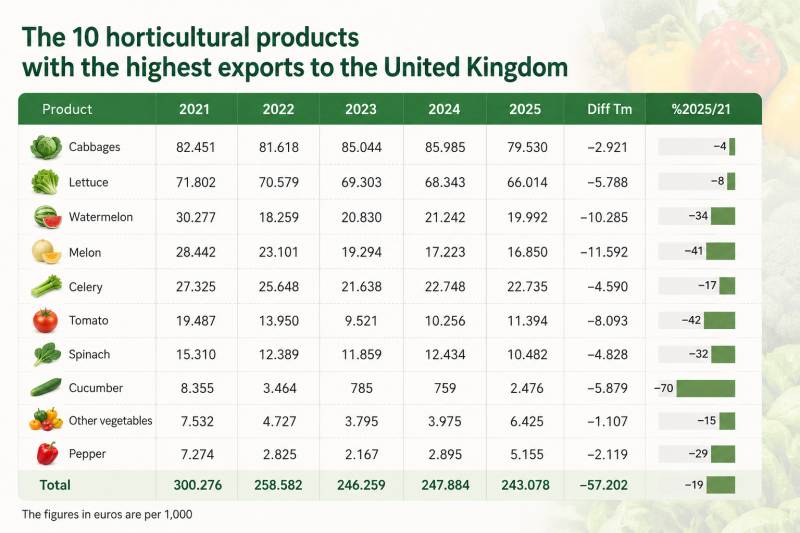
The figures, compiled by Proexport using Eurostat data, paint a picture of steady erosion. Fernando Gómez, Director General of Proexport, describes a "gradual and widespread decline" across all Murcian products, with some categories hit particularly hard. Cucumber exports are down 70%, tomatoes 42%, melons 41% and watermelons 34%. "Our biggest concern is that, since Brexit, British importers and supermarkets are increasingly turning to non-EU suppliers," Gómez says. "Products from Morocco, Turkey and Egypt are gaining shelf space at our expense."
The tomato story is the starkest illustration. Moroccan exports to the UK have grown by 157% since Brexit, reaching 126,203 tonnes, more than double Spain's current volume. José Hernández, president of the Paloma Fruit and Vegetable Group, puts it bluntly: the Region of Murcia now has just four tomato companies, compared to 31 at its peak.
Part of the problem is administrative. Since 2021, most fresh fruit and vegetables require a customs declaration and certificate of conformity to enter the UK market, adding cost and complexity at both ends of the supply chain. The UK had also threatened to introduce a mandatory phytosanitary certificate, which Gómez describes as something that would have been "a disaster for them and for us." It has been repeatedly delayed, which has provided some relief, but the threat has not gone away.
Logistics have become more complicated and expensive too. José Esteban Conesa, CEO of Primafrio, says the UK has been "completely bombarding all non-British trucks with fines. For the most ridiculous infraction, they'll fine you 500 or 600 pounds." Transport to Britain now costs more than equivalent journeys to other destinations, which squeezes margins and shortens the shelf life of fresh produce by the time it arrives.
The national picture is less severe but still instructive. Across Spain as a whole, fruit and vegetable exports to the UK have fallen 16.6% in volume since 2016, though their value has risen by nearly 30%. That sounds better until you factor in rising costs, which means higher revenues do not automatically translate into better profitability for growers. Murcia, by contrast, is losing ground on both volume and value.
Gómez does not pull his punches on what needs to change. "Spain was more competitive when the United Kingdom was part of the Union, and now it's clear that we're not as competitive. Either we change soon, or we'll leave the field open to competition."
With Brexit's tenth anniversary approaching and rivals continuing to gain ground, that warning is getting harder to ignore.
To be listed on the CAMPOSOL TODAY MAP please call +34 968 018 268.
To be listed on the CONDADO TODAY MAP please call +34 968 018 268.
Guidelines for submitting articles to Camposol Today
Hello, and thank you for choosing CamposolToday.com to publicise your organisation’s info or event.
Camposol Today is a website set up by Murcia Today specifically for residents of the urbanisation in Southwest Murcia, providing news and information on what’s happening in the local area, which is the largest English-speaking expat area in the Region of Murcia.
When submitting text to be included on Camposol Today, please abide by the following guidelines so we can upload your article as swiftly as possible:
Send an email to editor@camposoltoday.com or contact@murciatoday.com
Attach the information in a Word Document or Google Doc
Include all relevant points, including:
Who is the organisation running the event?
Where is it happening?
When?
How much does it cost?
Is it necessary to book beforehand, or can people just show up on the day?
…but try not to exceed 300 words
Also attach a photo to illustrate your article, no more than 100kb









 Ten years on from the Brexit vote, the consequences for Murcia's agricultural sector are still very much being felt. Total fruit and vegetable exports from the region to the United Kingdom have fallen by 26% in volume since 2021, the first full year after the UK effectively left the EU single market. In tonnage terms, that means a drop from 406,868 to 301,577 tonnes. Revenue has also slipped, down 6% from €550 million to €515 million.